Summary
Replaced a forced interaction model with an autonomy-based browsing experience after A/B testing showed greater exploration, similar connection-request activity, and stronger longer-term engagement.
Role
Lead UX Researcher & Product Strategist: Designed the experiment, conducted usability research, analyzed behavioral outcomes, and translated findings into product strategy.
APPROACH
Think-Aloud Usability Testing · Randomized A/B Experiment · Paired Bootstrap Confidence Intervals · Post-Rollout Behavioral Analysis
Team
PM · iOS Engineer · Backend Engineer
2.6x
Profiles viewed per day
2.1x
Sessions per day
+22%
Chat conversion
+18%
Profile visits per session
Context
Kardder is a social discovery platform designed to help people connect within real-world communities such as universities, clubs, and local events. Users primarily discovered one another by browsing nearby profiles and deciding whether to connect.
To encourage active participation, browsing required users to either send a connection request or permanently dismiss each profile before continuing. The assumption was that requiring a decision for every profile would increase the number of users who connected with one another.
On university campuses, however, people frequently encountered classmates, acquaintances, or mutual friends. Requiring an immediate connect-or-dismiss decision introduced social pressure that risked making the experience feel uncomfortable rather than supportive.
Should browsing optimize for immediate decisions or for connections users actually wanted to make?

Product Hypothesis
The product team believed that requiring users to decide whether to connect or dismiss before viewing another profile would increase connection attempts and, in turn, improve connection outcomes.
However, informal user feedback suggested that forcing decisions might discourage exploration, reduce engagement, and create social friction rather than helping users make intentional connections.
To evaluate these competing hypotheses, I designed a sequential mixed-methods research strategy that examined both behavioral and experiential outcomes before recommending a product decision.
Research Strategy
To reduce uncertainty around the product decision, I structured the research in three stages:
1. Qualitative usability testing (think-aloud)
I began with moderated think-aloud sessions to understand how users experienced the forced interaction model in real time. This revealed confusion, social pressure, and decision discomfort that would not have been visible through product metrics alone.
2. Randomized A/B experiment
Next, I ran a randomized experiment comparing forced and non-forced interaction models to measure behavioral outcomes at scale, including engagement, connection requests, and subsequent user interactions.
3. Longitudinal telemetry analysis
Finally, I analyzed post-rollout behavioral telemetry to evaluate whether the engagement gains observed during the experiment persisted over time.
Together, these stages ensured the product decision was informed by both user experience and behavioral evidence over time, rather than short-term engagement metrics alone.
Study 1: Think-Aloud Usability Testing
To understand how users experienced the forced interaction model in real time, I conducted moderated think-aloud usability sessions with 11 UCLA students using a version of the app that required them to either send a connection request or permanently dismiss each profile before continuing.
Participants created accounts and completed an open-ended discovery task to identify someone they might want to connect with. They were free to navigate the app however they chose, allowing me to observe natural browsing and decision-making behavior. Participants thought aloud throughout the task and completed a short follow-up interview, revealing how the forced interaction model shaped feelings of control, comfort, and social pressure.
Session recordings were systematically coded for recurring themes and independently reviewed by a second researcher to improve consistency across interpretations. This helped our team identify patterns in user behavior, verbal feedback, and post-task reflections.
What Users Experienced
The most consistent pattern was not decisiveness, but discomfort. Users often reacted with surprise when they realized they could not leave a profile without acting, describing the experience as confusing, rushed, and socially uncomfortable.
Five recurring themes emerged:
Disliking forced interaction. Most participants openly disliked being required to act on a profile before leaving it.
Feeling unprepared. Users wanted more time to compare profiles, sit with uncertainty, or revisit people later instead of deciding immediately.
Fear of missed opportunities. Permanently dismissing a profile felt unusually consequential because users worried they might want to connect with that person later.
Real-world social awkwardness. On a university campus, dismissing someone did not feel anonymous. Participants worried about future in-person encounters with people they had dismissed in the app.
Avoidance behavior. Some participants said they would become less likely to browse profiles at all if every interaction required an immediate decision.

Study 2: Randomized A/B Experiment
To evaluate the behavioral impact at scale, I designed a randomized between-subjects A/B experiment with 120 undergraduate participants. New users were randomly assigned to either the forced or non-forced interaction model and were unaware they were participating in an experiment, allowing behavior to remain as natural as possible.
Over a 14-day period, I measured profile views, session frequency, connection requests, accepted connections, and related behavioral outcomes. Because the retained telemetry consisted of condition-level daily aggregates, inferential analyses compared 14 matched calendar days per condition using paired tests and 10,000 paired bootstrap resamples.
Removing Forced Decisions Increased Exploration
Users in the non-forced condition explored substantially more than those in the forced condition. They viewed 2.6× as many profiles per day (95% paired-bootstrap CI: 1.87–3.88×; t(13) = -4.86, p = .0003) and initiated 2.1× as many sessions per day (95% paired-bootstrap CI: 1.76–2.67×; t(13) = -6.72, p < .001).
Together, these findings suggest that requiring users to act before continuing discouraged exploration, while the non-forced interaction model encouraged more frequent, self-directed browsing.

Connection Request Volume Remained Stable
Despite no longer being required to send a connection request before viewing additional profiles, users in the non-forced condition sent connection requests at a similar overall volume.
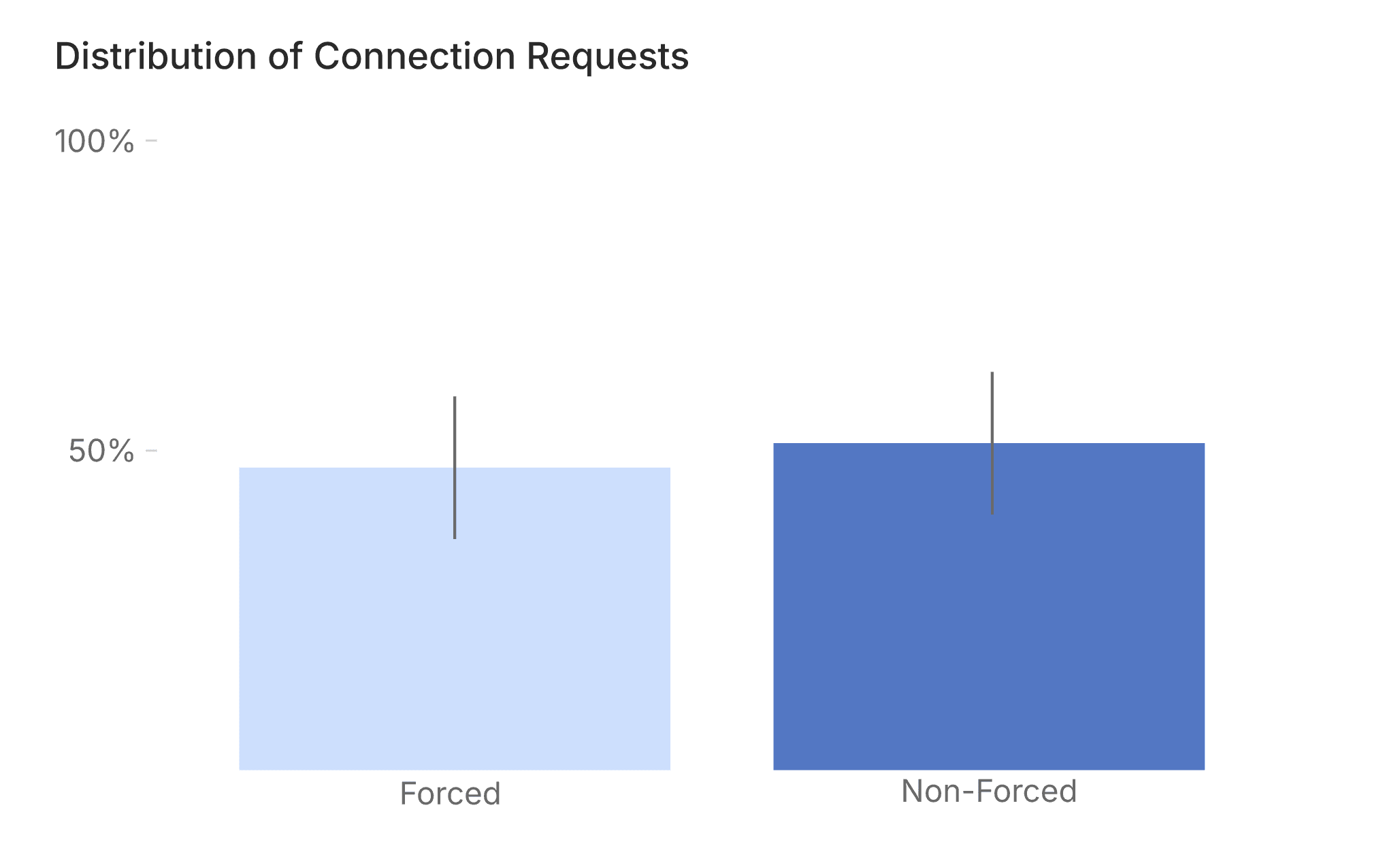
The forced condition accounted for 48.05% of connection requests (95% bootstrap CI: 36.03–58.68%), compared with 51.95% in the non-forced condition (95% bootstrap CI: 41.32–63.97%). Average request volume was 25.57 requests per day in the forced condition and 27.64 in the non-forced condition, with no detectable difference in the matched-day comparison (t(13) = −0.29, p = .774). The near-even split was especially important because the forced interaction model had originally been designed to increase connection attempts.
Instead, removing the requirement allowed users to explore substantially more profiles without an apparent reduction in connection-seeking behavior.
Non-Forced Users Evaluated More Profiles Before Connecting
Users in the non-forced condition evaluated substantially more profiles before sending a connection request. On average, they viewed 9.03 profiles per request (95% bootstrap CI: 6.55–11.72), compared with 3.22 in the forced condition (95% bootstrap CI: 2.45–4.22), a 2.8× increase (t(13) = −4.01, p = .0015).
Removing the forced interaction requirement allowed users to compare more potential connections before making a decision. Combined with the similar overall request volume, this suggests the redesign changed how users explored and selected potential connections rather than simply reducing connection activity.

Connection Outcomes Revealed a Potential Tradeoff
Extending the analysis to connection outcomes, 93.3% of requests were accepted in the forced condition (95% bootstrap CI: 88.8–97.3%), compared with 83.7% in the non-forced condition (95% bootstrap CI: 76.0–90.5%). This 9.6 percentage-point difference approached, but did not reach, the conventional significance threshold in the paired comparison (t(13) = 2.13, p = .053).
The result introduces an important qualification to the engagement gains. Removing the forced interaction increased exploration while overall request volume remained similar, but acceptance was directionally lower in the non-forced condition. The study therefore could not rule out a potential downstream tradeoff between greater freedom to explore and connection acceptance.

Tradeoff Analysis
The research revealed a potential tradeoff between exploration and connection outcomes. The forced interaction model encouraged earlier decisions and showed a higher acceptance rate per connection request, while the non-forced model allowed users to explore substantially more profiles and generated greater voluntary engagement.
Removing the forced interaction did not produce an apparent reduction in connection-request volume, but acceptance was directionally lower in the non-forced condition. Together, these findings showed that optimizing for a single metric could obscure meaningful differences in how users moved through the connection process.
The key insight was that no single behavioral metric captured the full product outcome. Evaluating the interaction model required considering exploration, engagement, request volume, and downstream acceptance together rather than optimizing any one measure in isolation.
Product Decision
Although leadership initially favored the forced interaction model because of its higher acceptance rate per request, the broader evidence revealed a more complex picture.
I reframed the discussion around three product considerations:
Connection activity as a whole, rather than acceptance rate alone.
User exploration and autonomy, rather than forced decision-making.
Sustained engagement, rather than short-term interaction efficiency.
The non-forced model substantially increased exploration and engagement without an apparent reduction in connection-request volume, while the acceptance results suggested a potential downstream tradeoff. Taken together, the broader product evidence supported transitioning to a fully non-forced browsing experience. Implementing the change required updates to browse interaction logic, notification behavior, reversibility states, and interface microcopy, and was rolled out across the product.
Long-Term Validation (60 and 120 Days)
To assess durability, I analyzed four months of post-rollout telemetry following the transition to non-forced browsing. Chat conversion increased by approximately 22%, while profile visits per session rose by roughly 18%.
These gains persisted well beyond the initial rollout, providing evidence that the behavioral changes were sustained rather than limited to a short-term novelty effect.

Product Impact
Replacing forced browsing with an autonomy-based interaction model increased engagement while preserving overall connection-request activity. Users explored substantially more profiles, initiated more sessions, and continued sending connection requests at a similar overall volume. Following rollout, chat conversion increased by approximately 22% and profile visits per session increased by roughly 18%.
Reflection
Like most early-stage product research, this work involved practical tradeoffs. Although the experiment included 120 randomized participants, the retained telemetry consisted of condition-level daily aggregates, so inferential analyses were conducted across 14 matched calendar days per condition, with paired bootstrap confidence intervals used to characterize uncertainty.
The evaluation window was also intentionally limited. Because the forced interaction model permanently removed profiles after each decision, extending the experiment would have increasingly changed the set of profiles available to users, introducing a confound unrelated to the interaction model itself.
Post-launch telemetry likewise reflected aggregate platform behavior rather than individual user trajectories, limiting my ability to determine whether engagement gains were broadly distributed across users or driven by a smaller subset of highly active participants.
Future work would benefit from participant-level longitudinal telemetry and a design that allowed the experimental window to be extended without changing the underlying choice set. Even with these constraints, the convergence of qualitative research, randomized experimentation, and longer-term telemetry increased confidence in the product decision.
Research Summary
Think-aloud usability testing (n = 11) with moderated interviews
Randomized between-subjects A/B experiment (n = 120)
Bootstrapped statistical analysis to compare behavioral outcomes
Longitudinal telemetry analysis over a 120-day post-launch period