Summary
Prioritized profile features by quantifying the relative importance of identity, compatibility, and media based signals through MaxDiff tradeoff modeling.
Role
Lead UX Researcher & Product Strategist: Designed and implemented a custom HTML/JavaScript MaxDiff platform with randomized trial generation, forced choice validation, and participant level statistical analysis.
APPROACH
Survey Research · MaxDiff Tradeoff Modeling · Bootstrap Confidence Intervals · Subgroup Analysis
Team
PM · iOS Engineer · Backend Engineer
1,095
Forced tradeoff evaluations
12
Profile attributes modeled
9
Trials per participant
16+ weeks
Development time saved
Table of Contents
Context
Product Question
Research Strategy
Study 1: Broad Signal Survey
Study 2: MaxDiff Tradeoff Experiment
Preference Hierarchy
Tradeoff Interpretation
Product Impact
Reflection
Limitations and Future Work
Research Summary
Context
Kardder's core interaction is profile-based social discovery. Users decide whether to initiate a connection largely based on the information presented on another person's profile.
Early qualitative interviews revealed that users struggled to "read someone's vibe" and often felt uncertain about whether to reach out. Participants suggested a wide range of improvements, including richer media, more detailed biographies, and additional context about each person.
If profile space was limited, which information actually influenced connection decisions the most?
This became a prioritization problem rather than a feature ideation problem.
Product Question
The challenge was deciding where to invest limited engineering effort. Users wanted richer profiles, but building every requested feature was neither practical nor strategically justified.
The product team faced three competing directions:
Expand profile expression through richer media, such as audio prompts and video introductions.
Deepen personal identity through more detailed biographies and articulated life goals.
Strengthen shared context through signals like mutual interests and mutual connections.
Design prioritization mattered. Investing in the wrong features could consume scarce development resources while delaying improvements that mattered most to users.
To establish a defensible prioritization strategy, I designed a staged quantitative research approach that moved from broad signal validation to forced tradeoff modeling.
Research Strategy
To prioritize future profile investments, I structured the research in two sequential phases.
1. Broad signal survey
I first conducted a breadth-oriented survey to identify which categories of profile information users believed influenced their decision to connect.
2. MaxDiff tradeoff experiment
I then implemented a MaxDiff (Best–Worst Scaling) experiment to force explicit tradeoffs between competing profile attributes and establish a defensible priority hierarchy.
The goal was not to validate a specific profile design, but to determine which profile components should be prioritized first under limited engineering resources.
Study 1: Broad Signal Survey
I conducted a select-all-that-apply survey with 81 undergraduate participants to identify which categories of profile information influenced connection decisions.
Participants evaluated a broad range of potential profile signals, including interests and hobbies, personality type, values and beliefs, shared experiences, career goals, and perceived "vibes."
Interests and hobbies were selected by 94% of participants, while more than half selected multiple additional categories, suggesting that many different types of information influenced connection decisions.
The survey successfully captured breadth of preference, but it did not establish meaningful priority. When nearly every profile attribute appeared important, the results provided limited guidance for product prioritization.

From Broad Preference to Forced Tradeoffs
Broad surveys are good at identifying what users value, but they are poor at establishing priority. When users evaluate profile features independently, many attributes appear important, making meaningful prioritization difficult.
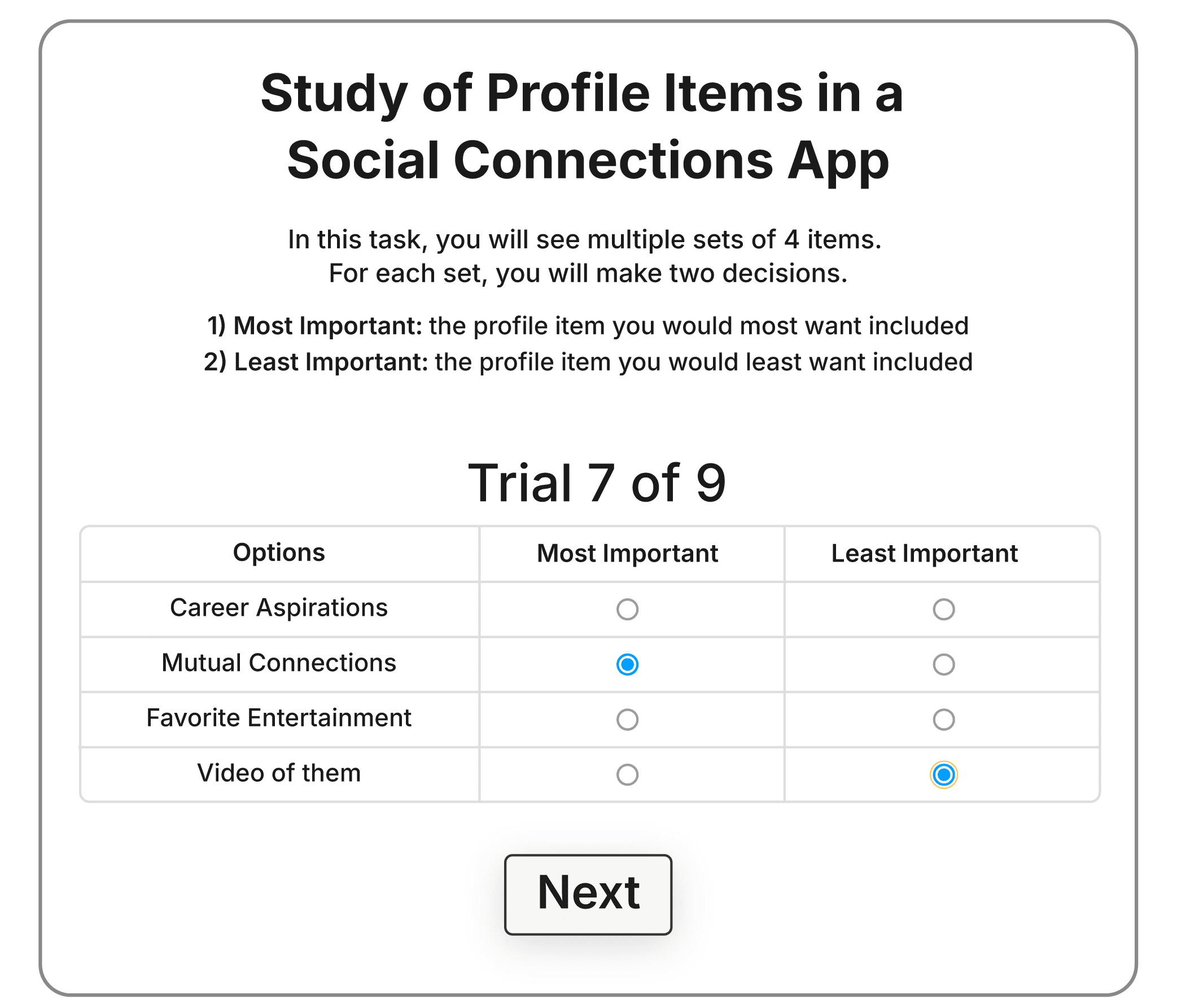
To address this, I designed and deployed a custom HTML/JavaScript MaxDiff (Best–Worst Scaling) experiment. In each trial, participants selected both the most important and least important attribute from a set of competing profile elements.
This forced participants to make explicit tradeoffs, producing a relative priority hierarchy rather than a collection of independent feature ratings.
For product decisions constrained by limited engineering resources, knowing what matters most is far more actionable than knowing what users like in isolation.
Study 2: Forced Tradeoff Experiment
This study examined which profile attributes users prioritized when forced to make explicit tradeoffs between competing forms of identity expression.
I designed and implemented a custom HTML/JavaScript MaxDiff (Best–Worst Scaling) experiment evaluating 12 candidate profile attributes, spanning both existing Kardder profile elements and proposed enhancements, including shared interests, biographies, life goals, causes and values, audio prompts, and video introductions.
Participants completed nine randomized tradeoff trials, selecting both the most important and least important attribute from each set of four competing profile elements.
The experiment produced a relative priority hierarchy, allowing direct comparison of which profile features users valued most when tradeoffs were unavoidable.
Participant Demographics
A total of 115 participants completed the experiment. Participants ranged from 18–25 years old and represented a variety of connection goals, including friendship, dating, and professional networking.
Preference rankings remained consistent across age, gender, and connection goals, suggesting the resulting hierarchy was broadly stable across participant subgroups.

Participant Connection Goals
Participants represented a broad range of connection goals, with friendship-oriented and hybrid social intentions appearing most frequently. Many participants selected multiple connection goals, suggesting a preference for platforms that support multiple forms of social connection rather than a single-purpose experience.
This diversity helped ensure that the resulting preference hierarchy reflected a broad range of user motivations rather than a single connection intent.

Randomization and Exposure Validation
To ensure that the resulting preference hierarchy reflected participant choices rather than the survey design, I evaluated how frequently each attribute appeared across all randomized trials.
Attribute exposure remained highly balanced throughout the experiment, as confirmed by a chi-square analysis showing no significant deviation from a uniform distribution (p > .05). This ensured that the resulting preference hierarchy reflected participant decisions rather than unequal exposure.

Experimental Design
Participants accessed a custom single-page HTML/JavaScript survey through a public URL and completed nine randomized MaxDiff trials, each presenting four competing profile attributes drawn from a balanced set of 12 candidate features spanning both existing Kardder elements and proposed enhancements. Across 115 participants, this produced a total of 1,035 forced tradeoff evaluations.
In each trial, participants identified both the most important and least important attribute, forcing explicit tradeoffs between competing forms of identity expression. Trial presentation was randomized across participants, and the interface enforced valid best–worst selections by preventing the same attribute from being selected as both most and least important within a single trial.
All statistical analysis and visualization were conducted using custom MATLAB scripts.
Preference Hierarchy
A clear preference hierarchy emerged once participants were forced to make explicit tradeoffs.
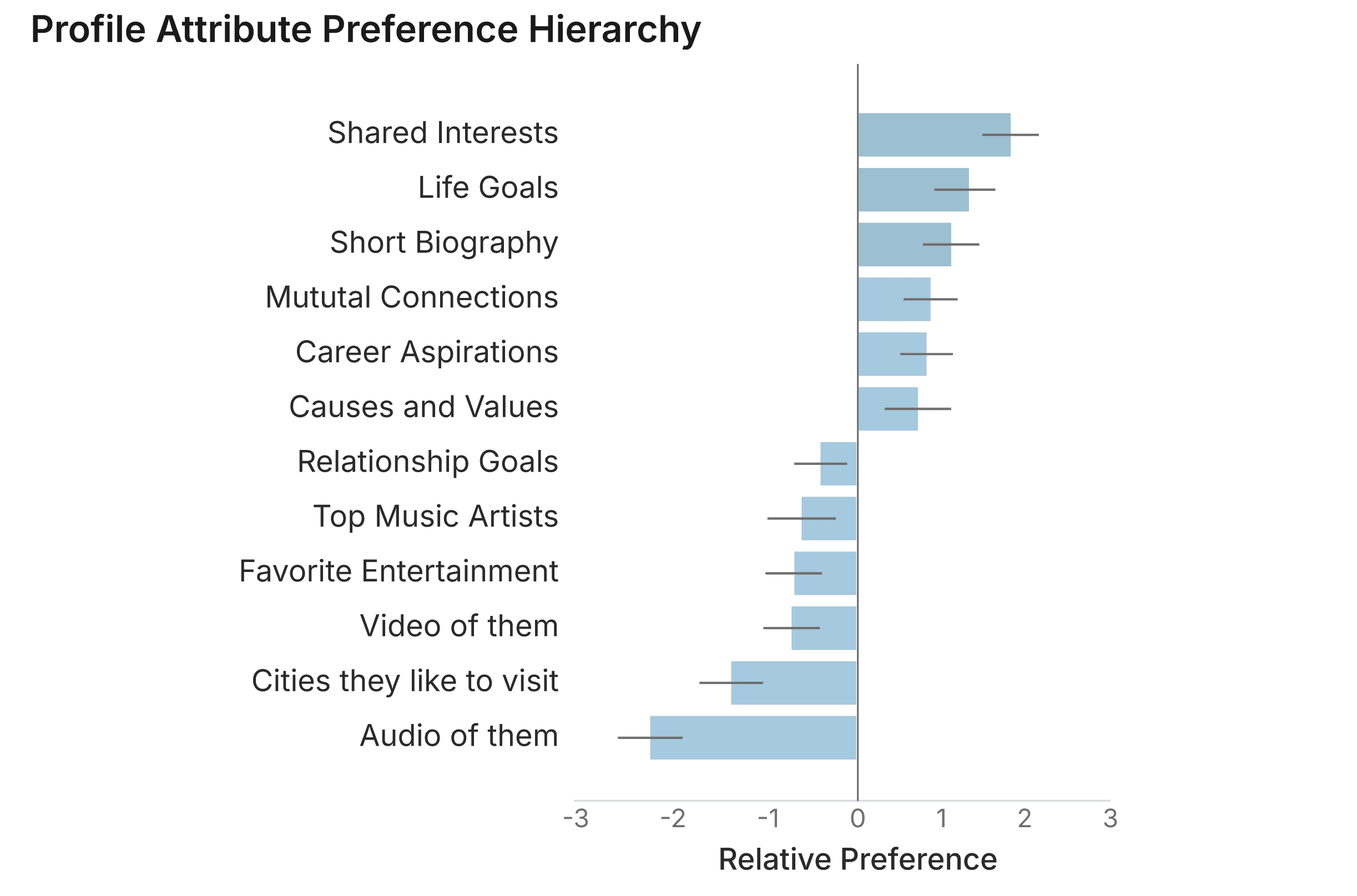
Shared interests consistently received the highest number of "Most Important" selections, followed by life goals, written biographies, mutual connections, career aspirations, and causes and values. In contrast, audio prompts and video introductions received disproportionately high numbers of "Least Important" selections.
These findings suggest that users prioritized shared context and articulated identity over richer media formats when deciding whether to connect.
To evaluate the stability of the preference hierarchy, I computed participant-level net preference scores and estimated 95% confidence intervals using 10,000-iteration bootstrap resampling. Foundational identity signals remained consistently positive, while media-oriented profile features remained consistently negative, suggesting that the hierarchy reflected stable preferences across the sample rather than being driven by a few participants.
Subgroup Consistency
The preference hierarchy remained remarkably consistent across participant groups. To examine whether preferences varied by user characteristics, I compared net preference scores across gender, age, and stated connection goals.
Only minor differences emerged across subgroups. Shared interests, life goals, written biographies, and mutual connections remained consistently prioritized, while audio prompts and video introductions remained consistently deprioritized.
The stability of the hierarchy suggests that these preferences reflected broad user priorities rather than the opinions of a single demographic segment.

Tradeoff Analysis
The findings challenged the implicit product assumption that richer media would communicate identity more effectively than traditional profile information.
Instead, users consistently prioritized shared context and articulated identity over richer media formats. Shared interests, life goals, written biographies, and mutual connections emerged as the strongest signals for evaluating potential connections, while audio prompts, video introductions, and entertainment-oriented features ranked substantially lower.
Importantly, these preferences remained consistent across gender, age, and connection goals, suggesting that the hierarchy reflected broad user priorities rather than the preferences of a specific subgroup.
For Kardder, this provided a defensible roadmap for product investment. Rather than prioritizing trend-driven media enhancements, the findings supported investing in clearer identity signals, articulated intent, and shared context within the profile experience.
Product Impact
This research did not result in a single new interface. Instead, it provided a defensible framework for product prioritization.
Based on the findings, the team:
Deferred investment in audio and video profile features.
Prioritized written biographies and shared-interest signals.
Reframed the profile experience around articulated identity rather than novelty-driven enhancements.
In an early-stage product, deciding what not to build can be just as valuable as deciding what to build. The findings provided quantitative justification for roadmap sequencing, redirecting more than 16 weeks of engineering effort toward higher-impact community and event features.

Reflection
This project reinforced the value of forced tradeoff methods for product prioritization. Qualitative research is excellent for uncovering unmet needs, but it is often less effective at determining what should be built first when many ideas appear valuable.
By translating broad preferences into a defensible priority hierarchy, this research reduced uncertainty before significant engineering investment.
Limitations and Future Work
Several limitations should be considered. The study focused on U.S.-based participants aged 18–25, and preferences may differ across broader populations. In addition, the experiment intentionally evaluated 12 candidate profile attributes, meaning other forms of identity expression were outside the scope of this research.
Future work could extend this framework through broader demographic sampling, expanded attribute sets, and live product experiments evaluating whether higher-priority profile signals translate into improved engagement and connection outcomes.
Research Summary
MaxDiff tradeoff experiment: 115 participants, 1,035 best–worst selections
Nine randomized tradeoff trials per participant with balanced attribute exposure
Prioritization of identity, shared-context, and media-based profile features
Bootstrapped confidence intervals and subgroup consistency analysis
Custom HTML/JavaScript experimental platform with statistical analysis performed in MATLAB